Rayleigh length
Rayleigh length – Definition & meaning
The Rayleigh length is a key parameter in laser optics. It describes how far a laser beam remains focused in the direction of beam propagation before it widens noticeably. The Rayleigh length therefore significantly determines the depth of field and focus stability of a laser. For industrial laser material processing—whether in laser cutting, laser welding, laser structuring, or additive manufacturing—it determines process quality, precision, and efficiency.
Physical basics of the Rayleigh length
The Rayleigh length is the distance from the beam waist—the point at which the laser beam reaches its smallest diameter—to the point at which the beam area has doubled.
For an ideal Gaussian beam (M² = 1), the following applies:
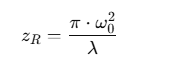
In real industrial applications, however, the beam usually deviates from the perfect Gaussian profile. This deviation is described by the beam quality factor M2. This results in the generalized formula:

- ω0: Radius of the beam at the focus (beam waist)
- λ: Wavelength of the laser light
- M2: Beam quality factor, which indicates how much the actual beam deviates from the ideal Gaussian beam (M² = 1 = perfect Gaussian beam)
In practical terms, this means that the better the beam quality (low M²), the longer the Rayleigh length and the more stable the focus remains. With a beam of poorer beam quality, the Rayleigh length is shortened accordingly.
Relationship between Rayleigh length and focus quality
The Rayleigh length is a decisive parameter for the focus quality of a laser beam and describes how long the beam remains nearly diffraction-limited in space before divergence increases. It thus determines the distance along the optical axis over which the focus is maintained with nearly constant intensity and beam geometry—a measure of the laser's depth of focus.
In practice, the Rayleigh length directly influences the stability of the energy input into the material. In processes where the focus position fluctuates slightly – for example, due to thermal expansion, material irregularities, or scanner movements – a longer Rayleigh length ensures a more robust and uniform processing result. Conversely, a short Rayleigh length enables extremely sharp focusing and thus a very high power density on the surface – crucial for precise, near-surface applications.
The Rayleigh length thus acts as a central link between optical system design and process-specific performance requirements: It defines how focused the beam remains over a given depth – and thus ultimately whether a laser process is optimized for maximum resolution or maximum stability.
The right balance depends heavily on the application. Therefore, the focus parameters are specifically optimized to balance process stability and detail accuracy.
Significance for industrial laser processing
The choice of the appropriate Rayleigh length directly influences the processing quality:
- In laser cutting, a long Rayleigh length ensures clean cut edges even with larger material thicknesses.
- In laser welding, longer focus stability enables a uniform molten pool.
- In laser engraving and micro-machining, short Rayleigh lengths offer the highest surface resolution.
- In additive manufacturing, process stability depends heavily on uniform energy distribution within the powder bed layer – this is where the Rayleigh length plays a key role.
Rayleigh length and beam guidance systems
The Rayleigh length is not solely a property of the laser, but is largely determined by the beam guidance systems and optics used. In addition to wavelength, focus size, and beam quality (M²), the beam diameter at the entrance to the optics and the system's free aperture also influence the achievable Rayleigh length.
- Beam diameter at the scanner entrance: The larger the incident beam diameter, the more the optics can focus the beam. A larger diameter, therefore, allows for a smaller focus and thus a shorter Rayleigh length, which is advantageous for high-precision applications such as microprocessing.
- Free aperture of the optics: The aperture of an F-theta lens or scanner lens limits how much of the laser beam is actually used. If the free aperture is too small relative to the beam diameter, the edge regions are cut off (“clipping”), which degrades beam quality and shortens the effective Rayleigh length.
- Scanner and optical design: High-quality beam deflection units and customized F-theta lenses ensure that the focus diameter, beam quality, and aperture are optimally matched. This keeps the Rayleigh length consistent across the entire processing field.
RAYLASE integrates customized optical solutions in combination with precise beam deflection units. By coordinating the beam diameter, free aperture, and scanner design, we ensure that the Rayleigh length exactly matches the process requirements—whether for high-speed processes, fine-structured engravings, or deep weld seams.
Optimization and monitoring of the Rayleigh length
In industrial applications, it is not sufficient to know the Rayleigh length in theory ; it must also be measured and optimized to ensure consistent focus quality and reproducible process conditions.
The Rayleigh length is usually determined experimentally by measuring the beam profile along the optical axis. The beam diameter is recorded at various z-positions and the position at which the area has doubled is determined.
Various methods are used for this purpose:
- CCD or CMOS-based beam profilers for high-resolution detection of intensity distributions,
- Knife-edge measurements (edge detection method) for precise focus curves,
- Confocal and interferometric methods for high-precision focus depth analysis in micro-machining processes.
The data obtained not only enables the validation of theoretical calculations, but also the monitoring of beam stability during operation.
RAYLASE supports companies in finding the optimal scanner and optics combinations. Our experts contribute their in-depth knowledge to precisely match the beam diameter and Rayleigh length to the process requirements – from high-power applications to the finest structuring.
Practical examples: Rayleigh length in use
The importance of the Rayleigh length is particularly evident in industrial applications where focus quality and process stability are directly decisive for success.
- Additive manufacturing:
In processes such as laser powder bed fusion (LPBF), a stable Rayleigh length is crucial. It ensures that the laser beam delivers its energy evenly, even with minimal height deviations in the powder bed. This prevents pore formation and ensures dense, reproducible components. In practice, a compromise is often chosen: a small focus for fine structures, but with sufficient Rayleigh length to compensate for process fluctuations. - Electronics manufacturing:
When structuring conductor tracks or processing thin layers (e.g., in displays or semiconductor processes), a short Rayleigh length enables maximum precision in the micrometer range. Since the processing usually only reaches a few micrometers deep into the material, a sharp focus is more important than depth of field. This is where scanners with a small free aperture and optimized beam transmission come into their own. - Medical technology:
When processing implants or surgical tools, a longer Rayleigh length is advantageous because it enables uniform energy input even on slightly curved or contoured surfaces. This results in smooth cut surfaces with minimal thermal impact on the surrounding tissue or material. - Laser cutting of metals:
With thick sheets, a longer Rayleigh length yields stable cutting across the entire material depth. The beam remains focused long enough to continuously penetrate the molten pool. Rayleigh lengths that are too short would lead to unstable cut edges or increased rework. - Laser welding:
In deep welding, an extended Rayleigh length is advantageous because it maintains an even melt pool across the entire welding depth. This reduces porosity and improves the seam's strength. - Microprocessing & structuring:
Applications such as the production of micro-holes, fine slits, or the laser structuring of surfaces require an extremely short Rayleigh length. It ensures that the laser beam only acts with maximum intensity in a very narrow area, allowing precise material removal with a minimal heat-affected zone.
These examples illustrate that the correct Rayleigh length is not a theoretical value, but a decisive lever for process quality, efficiency, and reliability in a wide variety of industries.
RAYLASE: Your reliable laser partner
The Rayleigh length is not a theoretical value, but a practical tool that determines the success of a laser process. RAYLASE understands the relationships between optics, scanners, and applications—and uses this knowledge to enable stable, efficient, and highly precise processes.
Whether for cutting thick sheets, high-resolution micro-machining, or additive manufacturing, we develop solutions that increase your productivity while ensuring process quality.

FAQs about the Rayleigh length
How is the Rayleigh length calculated?
The Rayleigh length is calculated from the focal radius and wavelength using the following formula
What does the Rayleigh length depend on?
It primarily depends on the focus size, wavelength, beam quality, and free aperture in the scanning system.
What are the advantages of a long Rayleigh length?
A long Rayleigh length ensures stable processes in deeper layers or on uneven surfaces.
What role does the Rayleigh length play in additive manufacturing?
In additive manufacturing, the correct Rayleigh length ensures even energy distribution in the powder bed, thereby improving component quality.